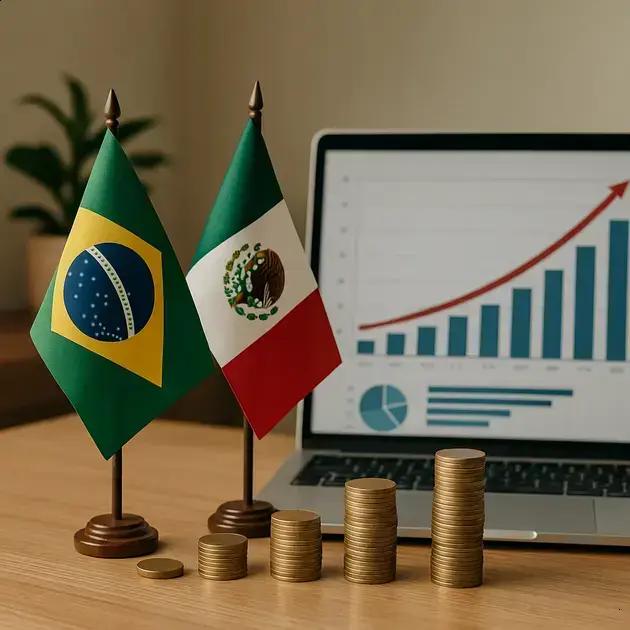
Brazil vs Mexico: Best Investment Destination in Latin America
Have you ever wondered which country leads Latin America as the best place for investments? The battle between Brazil and Mexico is always a hot topic among investors looking at emerging markets.
In this context, brazil vs mexico investment becomes crucial to understand, especially considering recent economic shifts and regional dynamics. Both countries offer unique advantages but also challenges that can impact your decisions.
Stick around as we break down key factors like GDP, political climate, and market opportunities, helping you get a clearer picture before committing your capital.
economic performance and gdp comparison
When comparing the economic performance of Brazil and Mexico, a key indicator is their Gross Domestic Product (GDP). Brazil’s GDP is the largest in Latin America, reflecting its diverse economy that spans agriculture, manufacturing, and services. It benefits from vast natural resources and a robust internal market.
Mexico’s GDP, meanwhile, is significant due to its strategic position as a manufacturing and export hub, with strong ties to the United States economy through trade agreements and supply chains.
Both countries have experienced fluctuations in growth rates influenced by global economic changes, domestic policies, and political stability.
GDP growth trends and comparison
Recent years have shown Brazil recovering from a recession, with its economy stabilizing due to reforms and increased commodity exports. Mexico has maintained steady growth, largely driven by manufacturing and export sectors.
Real GDP per capita is another important factor reflecting the standard of living and economic productivity, where Mexico’s higher export focus has led to more consistent per capita gains compared to Brazil’s variable commodity prices.
Understanding these economic nuances helps investors evaluate which country offers more sustainable growth opportunities depending on their investment goals.
political stability and regulatory environment
Political stability is a fundamental factor impacting investments in Brazil and Mexico. Brazil has faced periods of political uncertainty that influenced investor confidence, including recent changes in government policies and reforms aiming to boost economic growth. Despite challenges, initiatives focused on improving transparency and regulatory consistency have been implemented to create a more favorable business environment.
Mexico benefits from a relatively stable political framework supported by long-standing trade agreements like the USMCA. However, investors should consider local issues such as security concerns and shifts in regulatory policies that can impact certain sectors. Mexico’s proactive regulatory reforms often target improving ease of doing business and encouraging foreign direct investment.
Regulatory environment and business impact
Both countries have agencies dedicated to overseeing economic regulations. In Brazil, the National Agency of Petroleum, Natural Gas and Biofuels (ANP) plays a key role in regulating the energy sector, while Mexico’s National Commission for Regulatory Improvement (CONAMER) focuses on streamlining regulations.
The capacity to adapt to regulatory changes is vital for investors. Brazil’s complex tax system and bureaucratic processes can pose challenges, whereas Mexico’s labor laws and foreign ownership restrictions might influence investment strategies.
Strong legal protections and transparent institutions increase investor confidence, and both nations have made strides to enhance these aspects. Understanding local political nuances and regulatory trends helps investors navigate potential risks and identify opportunities effectively.
market capital and financial infrastructure
Market capital and financial infrastructure are crucial when deciding between Brazil and Mexico for investment opportunities. Brazil boasts B3, the largest stock exchange in Latin America, known officially as B3 S.A. – Brasil, Bolsa, Balcão. It provides extensive financial services, including equities, derivatives, and commodities trading, playing a key role in Brazil’s capital market.
Mexico’s main financial hub is the Mexican Stock Exchange, known as Bolsa Mexicana de Valores (BMV). It provides investors access to various instruments including stocks, bonds, and investment funds. Mexico’s proximity to the United States also enhances its financial connectivity and cross-border investment opportunities.
Key aspects of financial infrastructure
Both countries have developed a range of financial institutions and regulatory bodies to maintain market integrity and foster growth. For Brazil, the Comissão de Valores Mobiliários (CVM) regulates the securities market, ensuring transparency and investor protection. In Mexico, the Comisión Nacional Bancaria y de Valores (CNBV) fulfills a similar role, overseeing financial markets and institutions.
Foreign investors should consider factors such as market liquidity, availability of credit, and technological investment platforms. Brazil offers a diverse banking system with major banks like Banco do Brasil and Itaú Unibanco, while Mexico’s financial sector includes institutions like BBVA México and Citibanamex, both supporting robust capital flow.
Understanding these financial infrastructures helps investors evaluate ease of access to capital, efficiency of transactions, and overall market health, guiding strategic investment decisions between the two countries.
key sectors driving growth
Brazil and Mexico both have diverse economies, but certain sectors stand out as main drivers of growth. In Brazil, the agricultural sector is a powerhouse, with soybeans, coffee, and beef exports being significant contributors. The country is also a leader in mining, with abundant iron ore reserves, and has a strong industrial base focused on automotive and aerospace manufacturing.
Mexico’s growth is heavily influenced by its manufacturing sector, particularly automotive, electronics, and aerospace industries. The country’s strategic location near the United States enhances its export capabilities, making it a major hub for assembly plants and maquiladoras.
Technology and services sectors
Both countries have growing technology and service industries. Brazil’s fintech sector is expanding rapidly, driven by companies like Nubank, which is pioneering digital banking solutions. Mexico is also seeing growth in IT services and e-commerce, supported by increasing internet penetration and a young population.
These sectors offer investment opportunities characterized by innovation and high growth potential. Understanding which sectors are thriving helps investors align their strategies with emerging trends and economic strengths in each country.
risks and opportunities for foreign investors
Foreign investors considering Brazil and Mexico must evaluate both risks and opportunities carefully. Brazil offers vast potential due to its large market and rich natural resources. However, challenges include complex tax systems, bureaucratic hurdles, and occasional political instability that can affect market confidence.
Mexico, with its strategic location near the United States and strong manufacturing base, presents significant advantages for exports and trade partnerships. Yet, investors should be aware of security concerns and regulatory changes that can impact various sectors.
Key risks and mitigation strategies
- Political and regulatory risks: Both countries experience periodic policy shifts; investors can mitigate this by staying informed through local advisory services and establishing strong legal counsel.
- Economic volatility: Currency fluctuation and commodity price changes affect profitability. Diversification and hedging strategies help manage these risks.
- Market entry barriers: Navigating local regulations requires understanding official processes. Utilizing local expertise and partnerships can ease this challenge.
Opportunities remain abundant as both nations actively seek foreign direct investment with incentives in sectors like renewable energy, technology, and infrastructure. Aligning investment choices with these growing industries can maximize returns and long-term stability.
FAQ – Brazil vs Mexico: Best Investment Destination in Latin America
What are the main economic differences between Brazil and Mexico?
Brazil has a larger and more diverse economy with strong agriculture and mining sectors, while Mexico benefits from its manufacturing and export-focused economy, especially linked to the United States.
How stable is the political environment in Brazil and Mexico for investors?
Both countries face political challenges, but Mexico offers relatively more stability with steady regulatory reforms, whereas Brazil is working on improving transparency amidst occasional political shifts.
What financial infrastructure supports investments in Brazil and Mexico?
Brazil has B3, the largest stock exchange in Latin America, and strong financial institutions, while Mexico operates the Bolsa Mexicana de Valores and benefits from close ties with U.S. financial markets.
Which sectors are driving growth in Brazil and Mexico?
Brazil’s key sectors include agriculture, mining, automotive, and fintech, while Mexico is strong in manufacturing, electronics, automotive, and IT services.
What risks should foreign investors be aware of in these countries?
Investors should consider political and regulatory risks, economic volatility, currency fluctuations, and market entry barriers. These risks can be managed by local partnerships and risk diversification.
Are there opportunities for foreign investments in Brazil and Mexico?
Yes, both countries offer promising opportunities in renewable energy, technology, infrastructure, and export-driven industries, with government incentives to attract foreign direct investment.